What is Comment Intelligence? (and How to Actually Do It)
Brett Dashevsky
Amy Watts
Table of Contents
No headings found
Published
/
6 min read
TL;DR:
Comment intelligence is the practice of systematically analyzing comment sections - your own and everyone else's - for sentiment, recurring themes, and audience signal, rather than skimming them after a post goes live.
There are two feeds running on every social platform right now.
One is the feed brands spend all their time optimizing for: the content itself. The other has been growing its own audience, its own culture, and its own stars underneath every post for a while now: the comment section.
That second feed has its own logic, its own rhythms, and its own moments that travel independently of whatever's happening above them. People run straight to the replies, form opinions based on what others are saying, and tag friends in threads that sometimes have almost nothing to do with the original post. For a growing number of users, the comments are as much of a reason to engage as the content itself.
That second feed rarely gets read as closely as the post sitting above it. Here's why that needs to change, and how to actually read it well.
What is comment intelligence?
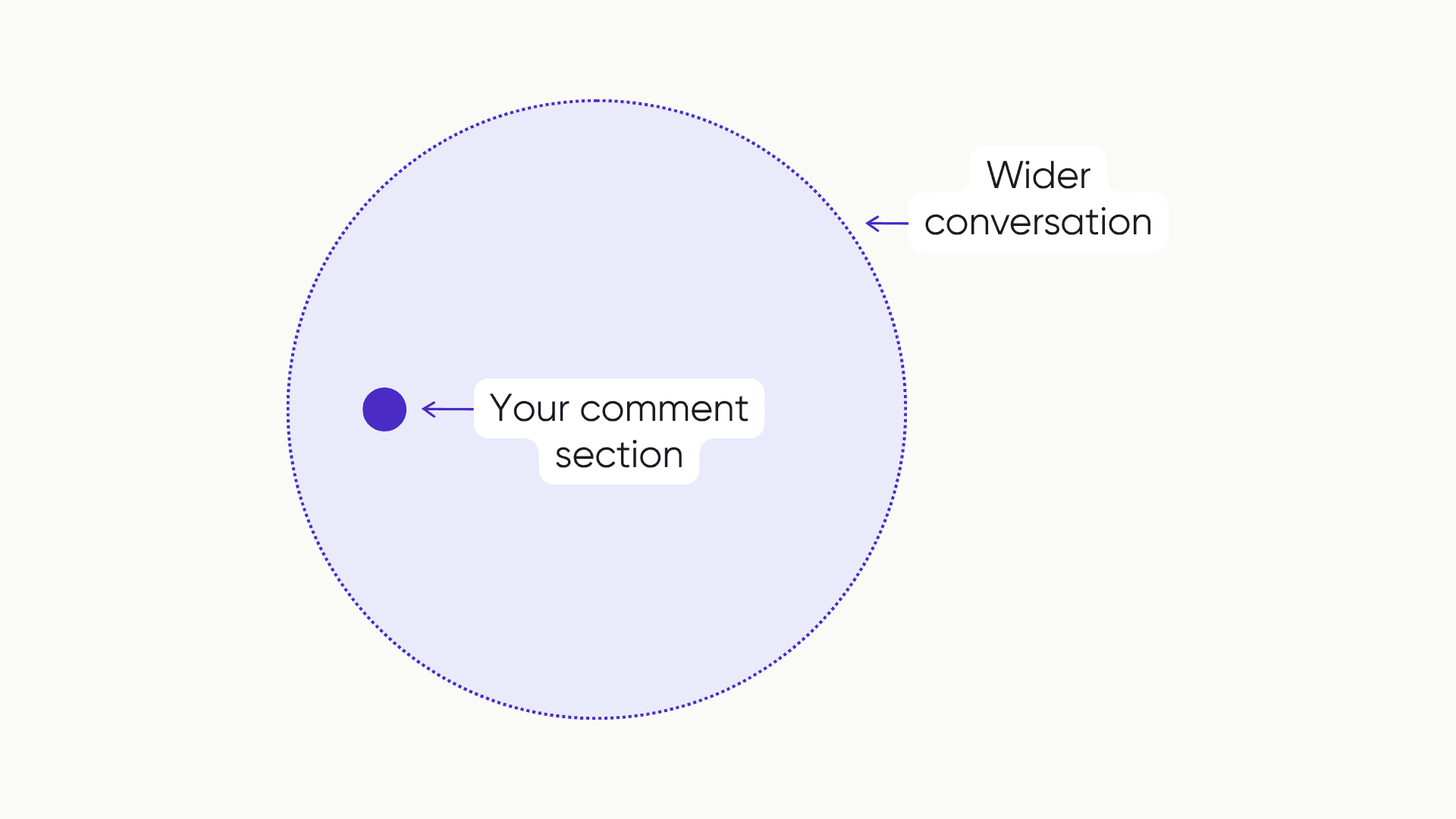
Comment intelligence is the discipline of treating comment sections as a primary source of audience data rather than a moderation queue. Instead of scrolling until something stands out, it means systematically reading for sentiment, recurring language, and the specific questions an audience keeps asking - across posts a brand owns and posts it doesn't.
Dashboards measure attention. Comment sections reveal intention - what people cared about enough to share out loud.
The moment content goes live, the comment section starts doing something the brief never planned for. It becomes a product request form, a customer service thread, a debate about something completely unrelated, or a full rewrite of what the post was originally supposed to be about.
Remember that video that went viral of McDonald’s CEO Chris Kempczinski taste-testing the Big Arch burger? The comment section fixated almost entirely on the fact that he referred to his own burger as a "product." Competitors showed up to take their shot. Marketers debated whether the moment was a calculated attempt to generate controversy or a genuine misstep by an executive who seemed unfamiliar with what he was selling to millions of people every day. Regular customers questioned whether the CEO even ate at McDonald's at all.
https://www.instagram.com/reels/DUTZ_ilDl41/
The conversation underneath the post took on a life of its own, and it ran for days.
Comments are basically the internet's subtext. While the post tells you what a creator wants you to see, the comment section tells you how the audience is actually reacting to it.
Comments are basically the internet's subtext. While the post tells you what a creator wants you to see, the comment section tells you how the audience is actually reacting to it.
Comments are basically the internet's subtext. While the post tells you what a creator wants you to see, the comment section tells you how the audience is actually reacting to it.
This isn't just a shift in audience behavior. Platforms have been actively building for it, and for a while now. The practical consequence is that what gets said in the replies accumulates weight over time. When a theme keeps recurring across thousands of comments, it starts to define how a brand is understood publicly. That understanding feeds into search, into AI-generated answers, and into how journalists, competitors, and new audiences first encounter the brand.
A comment section full of people questioning whether a CEO even likes his own product is shaping brand perception in ways that go well beyond the video it appeared under.
Why this matters more than it used to
Comment intelligence isn't a nice-to-have layer on top of social reporting anymore. The language building up in a brand's replies feeds into how platforms rank content, how AI systems describe a brand when someone asks about it, and how the wider narrative around a company forms in public, whether anyone on the social team is watching or not.
Social is no longer just a media channel — it's an input into how brands are understood everywhere, including search, LLMs, and earned media. If you're not thinking about how social conversations shape broader visibility, you're already several steps behind.
Social is no longer just a media channel — it's an input into how brands are understood everywhere, including search, LLMs, and earned media. If you're not thinking about how social conversations shape broader visibility, you're already several steps behind.
Social is no longer just a media channel — it's an input into how brands are understood everywhere, including search, LLMs, and earned media. If you're not thinking about how social conversations shape broader visibility, you're already several steps behind.
Treating the comment section as a primary source of intelligence - rather than something to glance at after a post goes live - turns a conversation that's already happening into something that actually feeds strategy, instead of something a team finds out about after the fact.
So what does comment intelligence actually involve?
At some point in most social careers, someone hands you a comment section and says some version of "find the insights." Maybe it's a campaign launch that needs a read, a creator deal that needs validating, or a competitor move worth keeping an eye on. Whatever triggers it, here's a framework for actually doing it, in order.
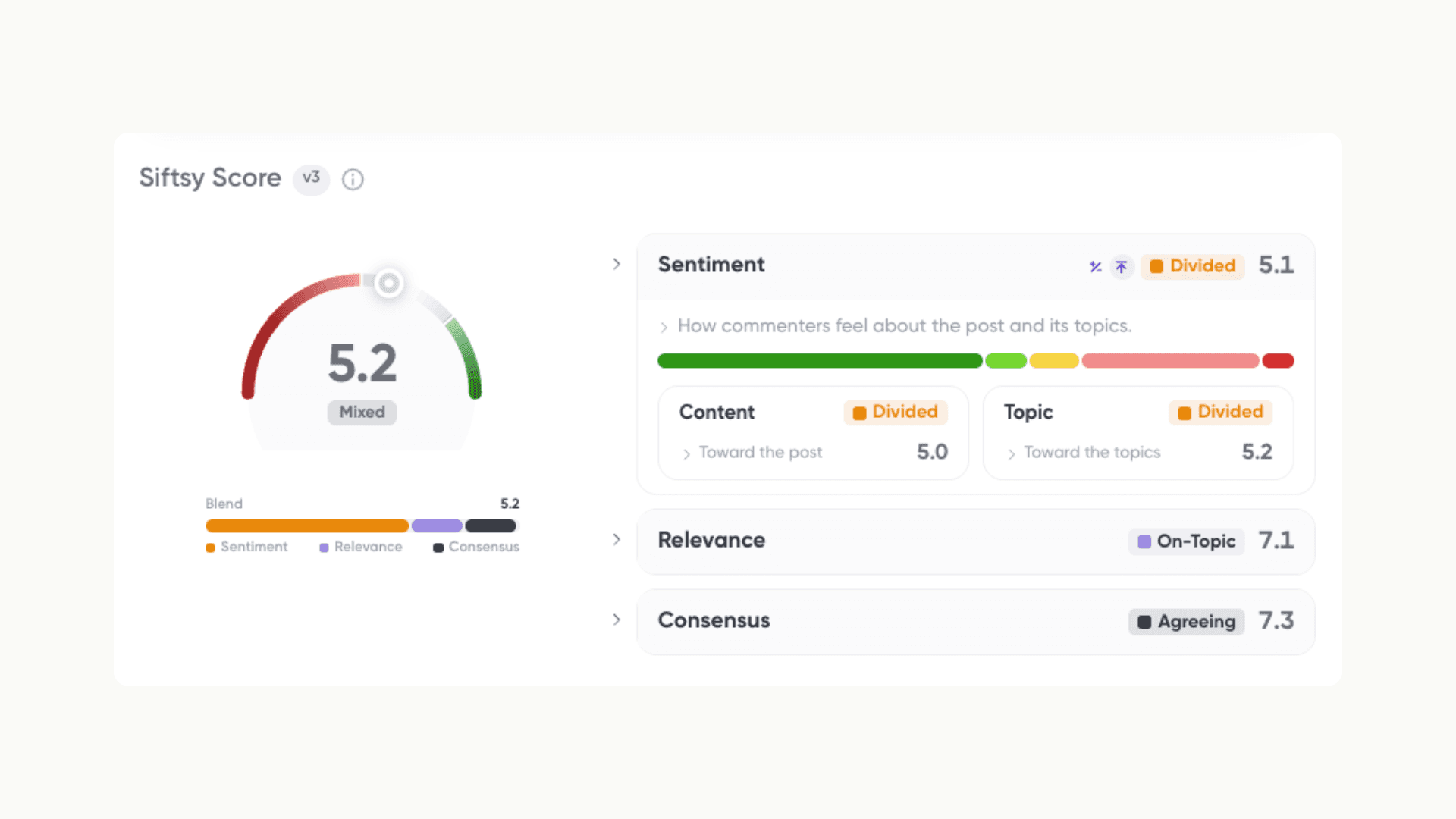
Step 1: Measure sentiment before anything else
The first instinct when opening a comment section is to look at how many comments there are. Skip that. Volume tells you whether a post generated a reaction, but it doesn't tell you what that reaction actually was, and starting there is how misreads happen.
How to do it:
Score the split between supportive, mixed, and negative comments before looking at anything else
Read sentiment in context, not in aggregate - thousands of positive comments about a creator can run alongside deeply negative comments about the product in the same thread, and those are two different signals that get lost if you average them together
Write the baseline down before moving to the next step, so later reads get measured against something concrete
Step 2: Surface what's actually being said
Once there's a sentiment baseline, move to discovery - and don't stop at what the platform shows you first. Algorithmic sorting surfaces the most liked or most recent comments by default. Those are rarely the most informative ones.
How to do it:
Sort by newest as well as top, and skim past the first screen of replies
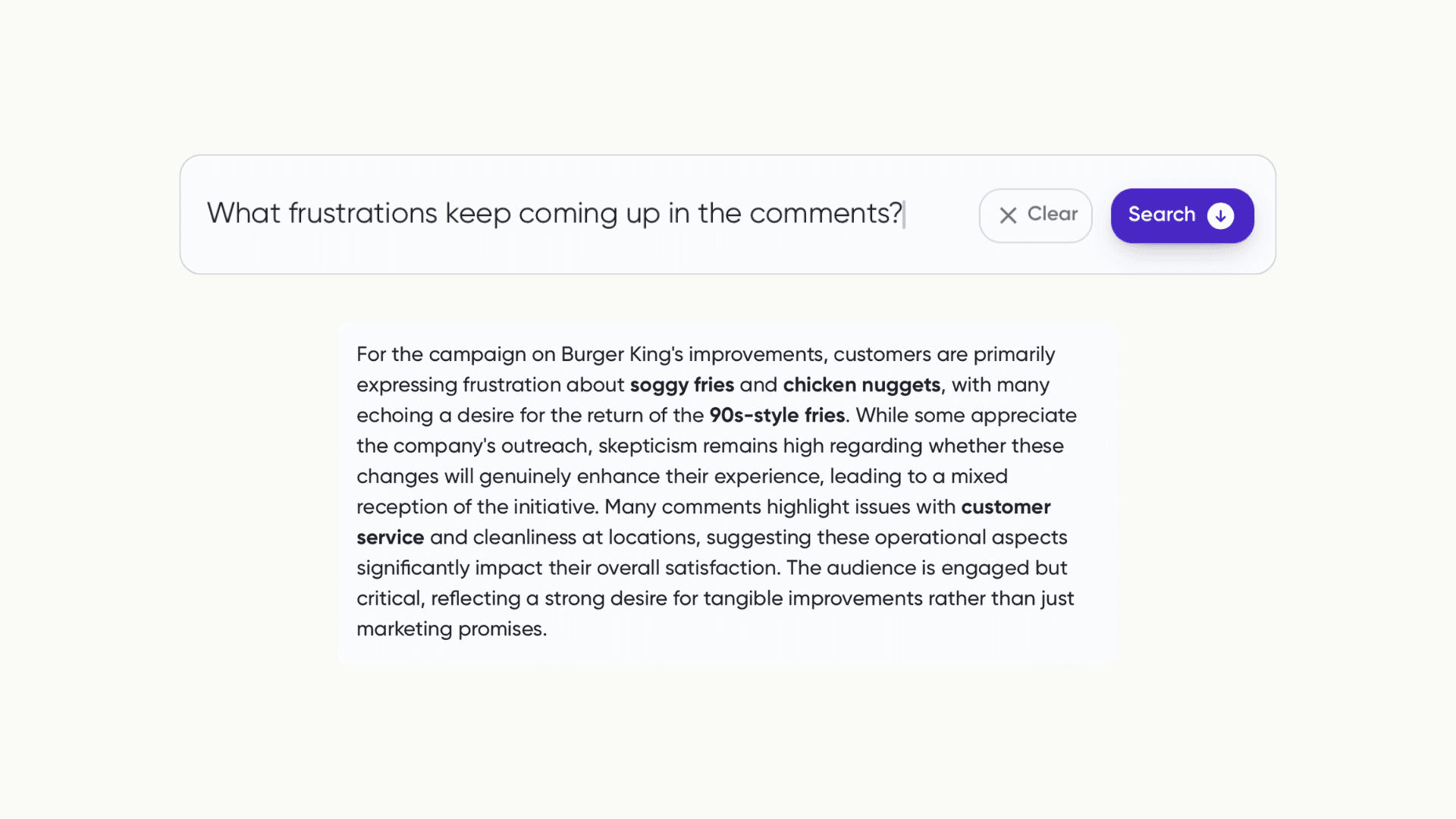
Look for language that repeats: the same question, the same complaint, the same joke showing up across multiple threads
Flag anything that's small right now but recurring - early, low-volume patterns are usually the first sign of where a conversation is heading, well before they show up in a sentiment score
Step 3: Validate against a specific question
This is the step teams skip most often, usually because they've run out of time - and it's the one that actually turns a scroll through the comments into evidence. Validation means going in with a specific question already in mind, not scrolling until something useful turns up.
How to do it:
Write the question down before opening the comment section: did the message land with the intended audience, did people connect with the creator or the product, what did people make of the price
Look for comments that would prove the assumption wrong, not just ones that confirm it
Treat a lack of evidence either way as a real answer - if the comments genuinely don't address the question, that's worth reporting too, rather than stretching a read to fit
The three parts feed into each other
Measurement gives a baseline.
Discovery gives texture.
Validation gives the specific evidence needed to back up a decision.
Comment analysis often skips straight from "I read some comments" to "here's what I think," and that jump is where the gaps in reporting come from. The signal is always in there. The question is how systematically anyone goes looking for it.
Common questions
Is comment intelligence the same as social listening?
Do you need to own the content to analyze its comments?
What's the difference between comment intelligence and sentiment analysis?
Where to start
The great news about comment intelligence is that you don’t need special tools to get started. Twenty minutes and a notebook in a comment section will get you further than a typical social report manages in a month.
But once you're doing this across dozens of posts, multiple platforms, and comment sections that aren't even yours to begin with, reading manually becomes unscalable.
Siftsy exists to take that framework and run it at scale - across every comment section that matters to a brand, not just the ones with time to spare.